In ZWDS, the Birth Year Palace (生年宫) and Body Palace (身宫) each occupy one of the 12 Palaces in a natal chart. These two palaces are often overlooked by beginners, but traditional practitioners consider them essential, as they reveal the underlying patterns that shape the first and second halves of a person's life.
How to Find the Birth Year Palace
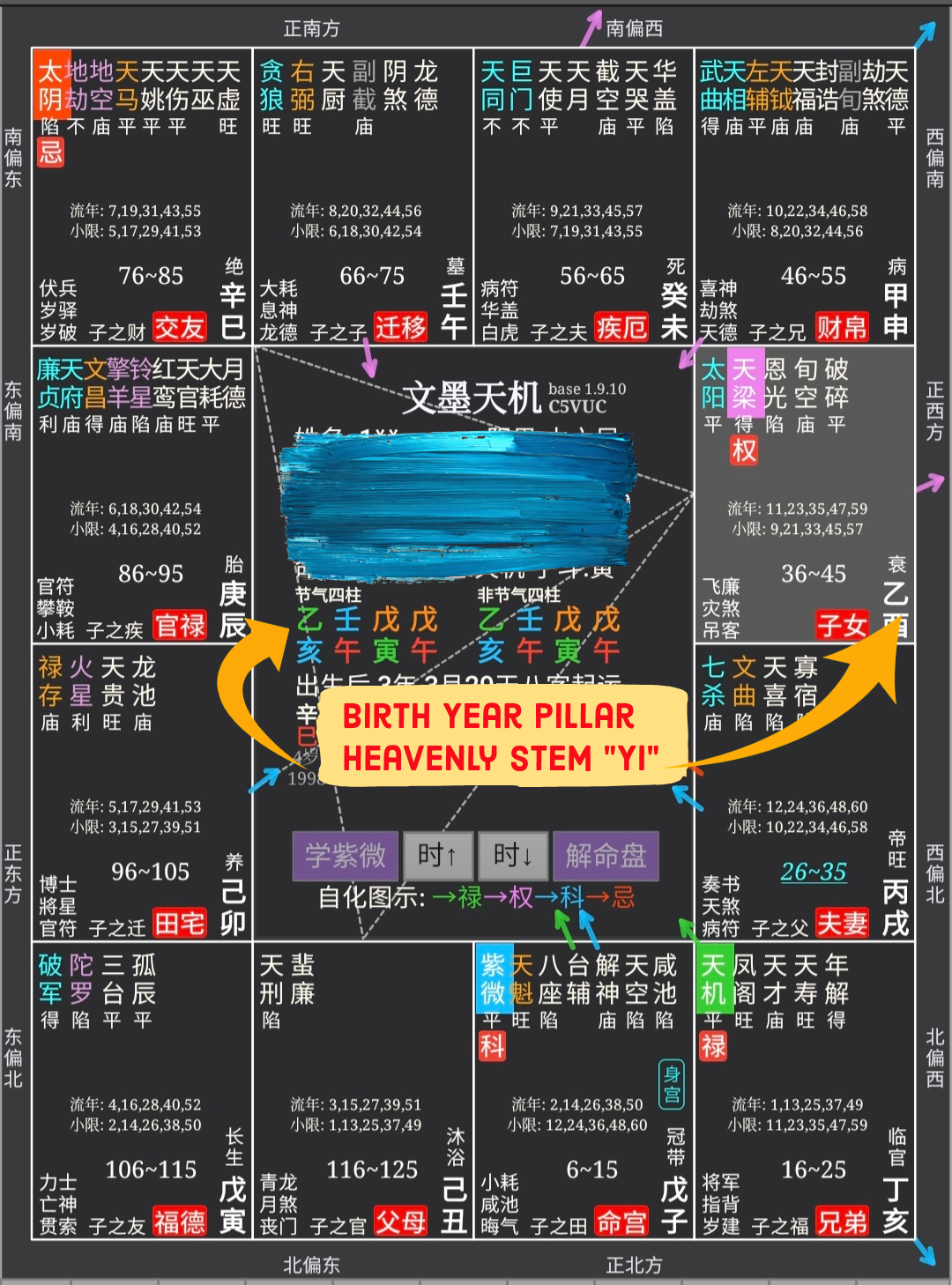
The Birth Year Palace is determined by the Heavenly Stem of the Year Pillar in BaZi. Find which Heavenly Stem governs the year of birth, then locate the palace in the ZWDS chart that shares the same Heavenly Stem. That palace becomes the Birth Year Palace.
For example, if the Year Pillar is Yi-Hai (乙亥), the Heavenly Stem is Yi (乙). Find the palace in the ZWDS chart where Yi (乙) appears. In the chart below, Yi falls in the Children Palace, so the Children Palace is also the Birth Year Palace.
What the Birth Year Palace Represents
Lifetime Influence
The Birth Year Palace tends to exert its strongest influence from childhood through early adulthood. As a person approaches middle age (traditionally around 40), the Birth Year Palace's influence gradually recedes, and the Body Palace begins to take priority in shaping the underlying themes of life.
Subconscious Character
Traditional practitioners associate the stars in this palace with the person's deeper personality: the traits most visible to close family and partners, and less visible to the outside world. This subconscious layer tends to be more prominent in the first half of life.
Early Life Focus
The palace where the Birth Year Palace falls indicates what the person tends to focus on during their formative years. In the example above, the Birth Year Palace in the Children Palace is traditionally associated with early interest in creative pursuits and passion projects, and in some cases with romantic involvement and parenthood at a younger age than peers.
The 4 Transformations
The 4 Transformations from the Birth Year Palace reveal patterns in early life:
- Hua Lu (化禄): Traditionally indicates natural talent and the areas where life tends to flow most easily.
- Hua Quan (化权): Points to where and when decision-making authority tends to develop.
- Hua Ke (化科): Associated with reputation-building, academic achievement, or social recognition.
- Hua Ji (化忌): Highlights where problems tend to arise.
How to Find the Body Palace
The quickest way: your birth hour alone tells you which palace holds the Body Palace.
| Birth hour | Body Palace |
|---|---|
| Zi (子) or Wu (午) | Life Palace |
| Chou (丑) or Wei (未) | Fortune Palace |
| Yin (寅) or Shen (申) | Career Palace |
| Mao (卯) or You (酉) | Travel Palace |
| Chen (辰) or Xu (戌) | Wealth Palace |
| Si (巳) or Hai (亥) | Marriage Palace |
To find it on the chart, count in two steps, using your birth month and two-hour birth period in the Chinese calendar:
- Start at the Yin (寅) palace as the first month, and count forward one palace per month to your birth month.
- From that palace, count forward again, one palace per two-hour period, starting with the Zi (子) hour, until you reach your birth hour. That palace is the Body Palace.
Example: born in the third month, in the Chen (辰) hour. Step 1: Yin, Mao, Chen, so the third month lands on Chen. Step 2: from Chen, the Zi, Chou, Yin, Mao and Chen hours land on Chen, Si, Wu, Wei and Shen. The Body Palace is on Shen, which is this chart's Wealth Palace, as the table shows for a Chen hour.
What the Body Palace Represents
Later Life Focus
The Body Palace (身宫) traditionally gains prominence in the second half of life, roughly after age 40. It reflects what the person tends to focus on as their priorities shift, and how their character develops with maturity.
Connection to Earlier Patterns
The Body Palace also reflects the cumulative effect of earlier life choices and circumstances. The patterns established during the Birth Year Palace's period of influence tend to shape what the Body Palace activates later.
Reading the Body Palace
The palace where the Body Palace falls indicates the dominant life theme after middle age. For example, if the Body Palace lands in the Life Palace, the person tends to become increasingly focused on self-development and personal standing. If it falls in the Career Palace, professional identity tends to become the central theme.
Like the Birth Year Palace, the Body Palace has its own set of 4 Transformations. These show which areas of life tend to be favorable or challenging in the later years.
When Both Palaces Share the Same Position
In most charts, the Birth Year and Body Palaces occupy different palaces. However, in some cases both fall in the same position. Traditional practitioners consider this significant: it suggests that the person's core focus and life themes tend to remain consistent throughout life, without the usual shift around middle age. The themes of that shared palace carry particular weight across both halves of life.